
Costa Natura: a Place, Not a Legal Fiction
Costa Natura: a place in south Spain
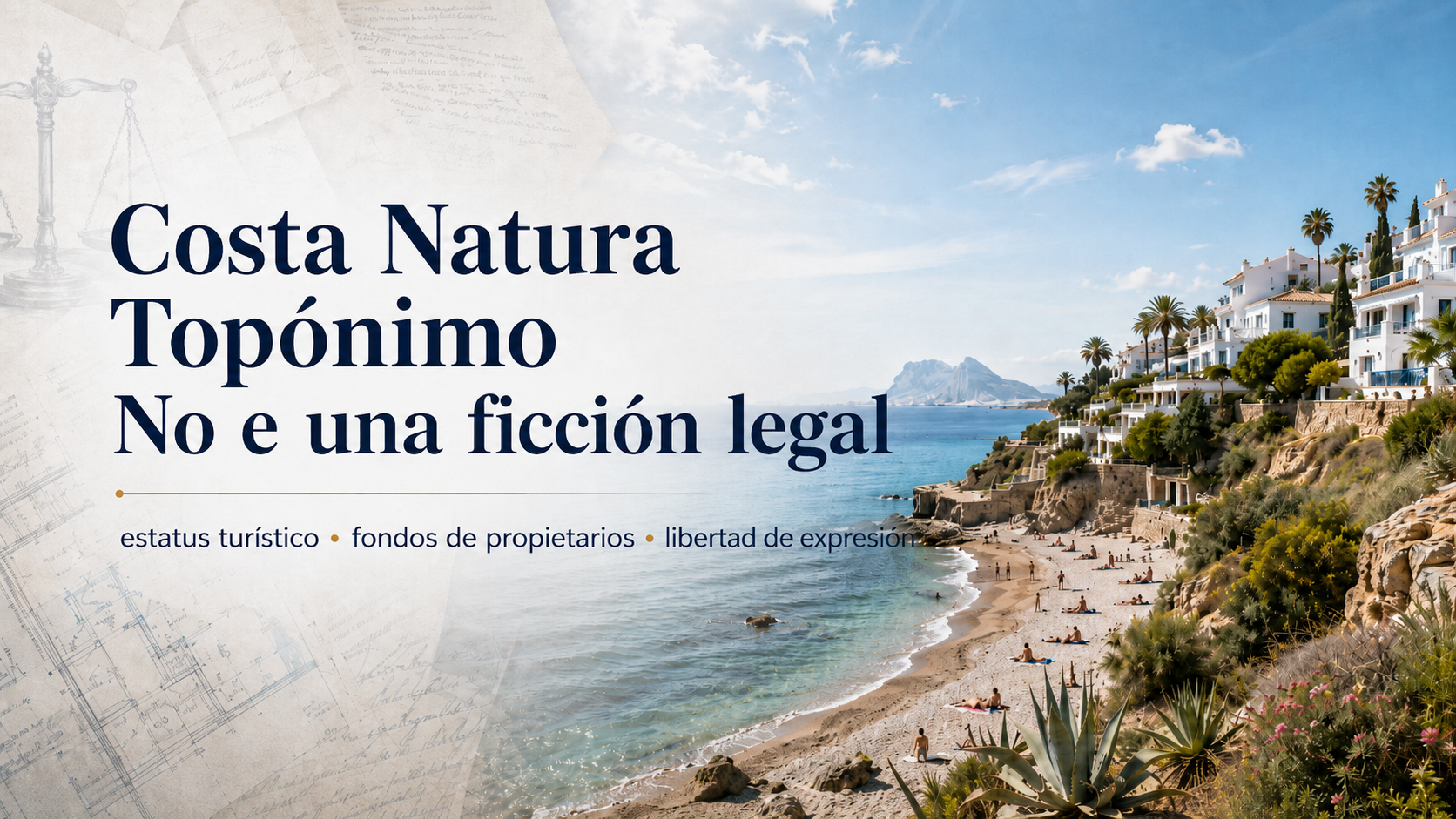
Before law, before marketing, before notaries, before tourist registers, before community minutes, before invoices, before threats, before criminal complaints, there is a place on the Mediterranean coast near Estepona, in Málaga Province, Andalusia, Spain. It has views toward Gibraltar and Africa. It has a beach, buildings, paths, plants, memories, bodies, visitors, owners, workers, histories, and absences.
That place should not be confused with any one legal structure created around it.
Costa Natura is not merely a trademark. It is not merely a community of homeowners. It is not merely an association. It is not merely a rental office, reception desk, tourist registration, website, president, lawyer, administrator, committee, notary deed, municipal file, regional authorisation, or commercial brand.
It is a toponym: a name for a place.
That distinction matters because much of the conflict around Costa Natura appears to arise from a long habit of collapsing the place into whatever legal fiction happens to be convenient at any given moment.
A tourist resort, a homeowners’ community, or both?
The documentary problem, as I understand it, is this.
Archival material appears to show that Costa Natura was originally approved as a commercial tourist resort. Later, other documents appear to have treated, reframed, administered, or represented the same place as a community of homeowners under horizontal property law. If that transition was not properly enacted, authorised, registered, licensed, or reconciled with the original public-law approval, then the problem is not a semantic curiosity. It is structural.
A commercial tourist resort and a residential community of owners are not the same thing.
They have different legal consequences. They generate different tax consequences. They imply different duties of transparency. They create different risks for owners, guests, workers, neighbours, public authorities, and consumers. They also determine who may lawfully take money, who may speak for whom, who may use the name of the place, and who may claim to control access to what is in reality partly a coastal public environment.
My concern has never been that Costa Natura is beautiful. It is beautiful. My concern is that beauty has been used as camouflage.
The problem of money
The criminal accusation against me concerns, among other things, my use of words such as misappropriation.
That word was not chosen casually. It was used because financial records, meeting minutes, budgetary lines, legal-fee entries, invoices, court records, and correspondence appeared to show large sums being charged, authorised, projected, transferred, or justified in ways that I considered impossible to reconcile with informed approval by the relevant owners.
In particular, I identified a discrepancy of more than €150,000 in legal payments connected with Javier Chacón. I asked why a much smaller approved sum appeared to have been converted into a much larger financial burden. I asked why legal costs appeared to have been projected forward, repeated, expanded, or disguised. I asked who had authorised them. I asked who had benefited. I asked why owners, many of them foreign and absent, had not been given a clear and comprehensible account.
Those were public-interest questions about money.
They were not threats. They were not private malice. They were not an attempt to wound a reputation for sport. They were questions about documented financial governance in a coastal development presented to the public as a naturist destination.
If the imputed criminal fact is provable from documents held by courts, lawyers, regulators, archives, public administrations, or the parties themselves, then the correct response is not intimidation. The correct response is disclosure.
The association problem
One of the strangest legal creatures in this story is Asociación Naturista Costa Natura.
On paper, it is a non-profit association. Yet the documents I have seen suggest that it has been connected with access to installations, social-club functions, services, tourism-facing activity, property-related assistance, rental or sales activity, and the maintenance or improvement of common elements connected with the wider place called Costa Natura.
That combination raises obvious questions.
Was the association created to promote naturism, or to operate commercial functions through non-profit clothing? Was it used to separate income, risk, tax, labour, rental activity, tourism registration, and decision-making from the ordinary transparency obligations that should apply to owners and public authorities? Was it a genuine civic association, or a mechanism by which a state-sanctioned commercial enterprise could be made to appear like something else?
My allegation is that Asociación Naturista Costa Natura has functioned less like an ordinary naturist association and more like an instrument within a wider structure of legal, commercial, fiscal, and administrative evasion.
That allegation is serious. It is also document-based.
Anyone who says it is false should publish the accounts, minutes, authorisations, licences, contracts, tax records, and legal opinions that prove it false.
Anger is not the opposite of evidence
I was angry.
I remain angry.
But anger is not the opposite of evidence. Anger is sometimes the human response to evidence being ignored.
It is possible that some local actors in Málaga, Andalusia, Spain, or the European Union were themselves operating inside larger structures of confusion, fear, dependency, professional loyalty, political embarrassment, or inherited legal fiction. Some may have believed they were protecting a place they loved. Some may have felt trapped by decisions made long before them. Some may have obeyed higher authority without asking whether that authority had lawful foundation. Some may have mistaken local custom for law. Some may have mistaken power for truth.
Others, in my opinion, knew exactly what they were doing.
Either way, the result was the same: a place was buried under layers of legal imagination, and people who asked questions were treated as the problem.
Defamation law as a shield for bad authority
The core issue is not whether powerful people dislike being criticised. Of course they dislike being criticised.
The issue is whether criminal defamation law should be used to punish public-interest speech about suspected financial wrongdoing, legal irregularity, tax avoidance, institutional failure, and misuse of governance structures.
My position is simple.
Where speech concerns the governance of a place marketed to the public; where it concerns money paid by owners; where it concerns lawyers, administrators, office-holders, associations, tourism registers, and public authorities; where it concerns documents rather than gossip; and where it concerns possible structural wrongdoing rather than private insult, that speech deserves the highest protection.
European and international human-rights principles should protect public-interest criticism, whistleblowing, satire, and value judgments based on disclosed facts. Spain’s older criminal defamation machinery should not be available as a weapon for silencing scrutiny of coastal legal fictions.
If my calculations are wrong, publish the corrected accounts.
If my interpretation is wrong, publish the legal basis.
If my terminology is excessive, explain precisely which documents disprove it.
But do not pretend that a criminal complaint answers a financial question.
Costa Natura, CHM de Montalivet, Pedras d’el Rei
Costa Natura should also be understood comparatively.
CHM de Montalivet, on the Gironde coast of France, is likewise more than the companies, leaseholders, operators, associations, shareholders, or authorities that may temporarily control parts of it. It is a place, a history, a toponym, and a living naturist landscape.
Pedras d’el Rei, on Portugal’s Algarve coast, may deserve similar scrutiny. Coastal places can be captured by legal structures that present themselves as inevitable, traditional, communal, touristic, or administrative, while quietly transferring value, risk, silence, and liability onto those least able to understand the machinery.
That is why toponyms matter.
A place is not the same as the gang that claims to manage it.
A beach is not the same as a balance sheet.
A naturist tradition is not the same as a tax arrangement.
A community is not the same as the people who intercept its documents.
An invitation to correction
This article is not written to destroy Costa Natura. It is written because Costa Natura deserves better than legal fog.
I invite any person, lawyer, public authority, association officer, former officer, owner, worker, journalist, archivist, notary, court official, tax authority, tourism inspector, or historian to correct, complete, or clarify the documentary record.
If Costa Natura was lawfully transformed from a state-sanctioned commercial tourist enterprise into a community of homeowners, show the instrument by which that happened.
If Asociación Naturista Costa Natura has not been used to disguise commercial or fiscal activity, publish the documents that prove it.
If legal fees were properly authorised, publish the authorisations.
If no money was misappropriated, publish the accounts in a form that ordinary owners can understand.
If the criminal complaint against me is not a SLAPP, explain why criminal procedure was a proportionate response to documented public-interest criticism.
Until then, I will continue to distinguish the place from the legal fictions built around it.
Costa Natura is a place.
It should not be governed by fog.